

Mapping Relational Intelligence
Many people spend years trying to “fix” their relationship without realizing they're working with an outdated map. (Spoiler alert: I was one of them.)
The relationship map we are handed by our parents and general society is often pretty straightforward: find someone you like, get married, and then basically: get on with it.
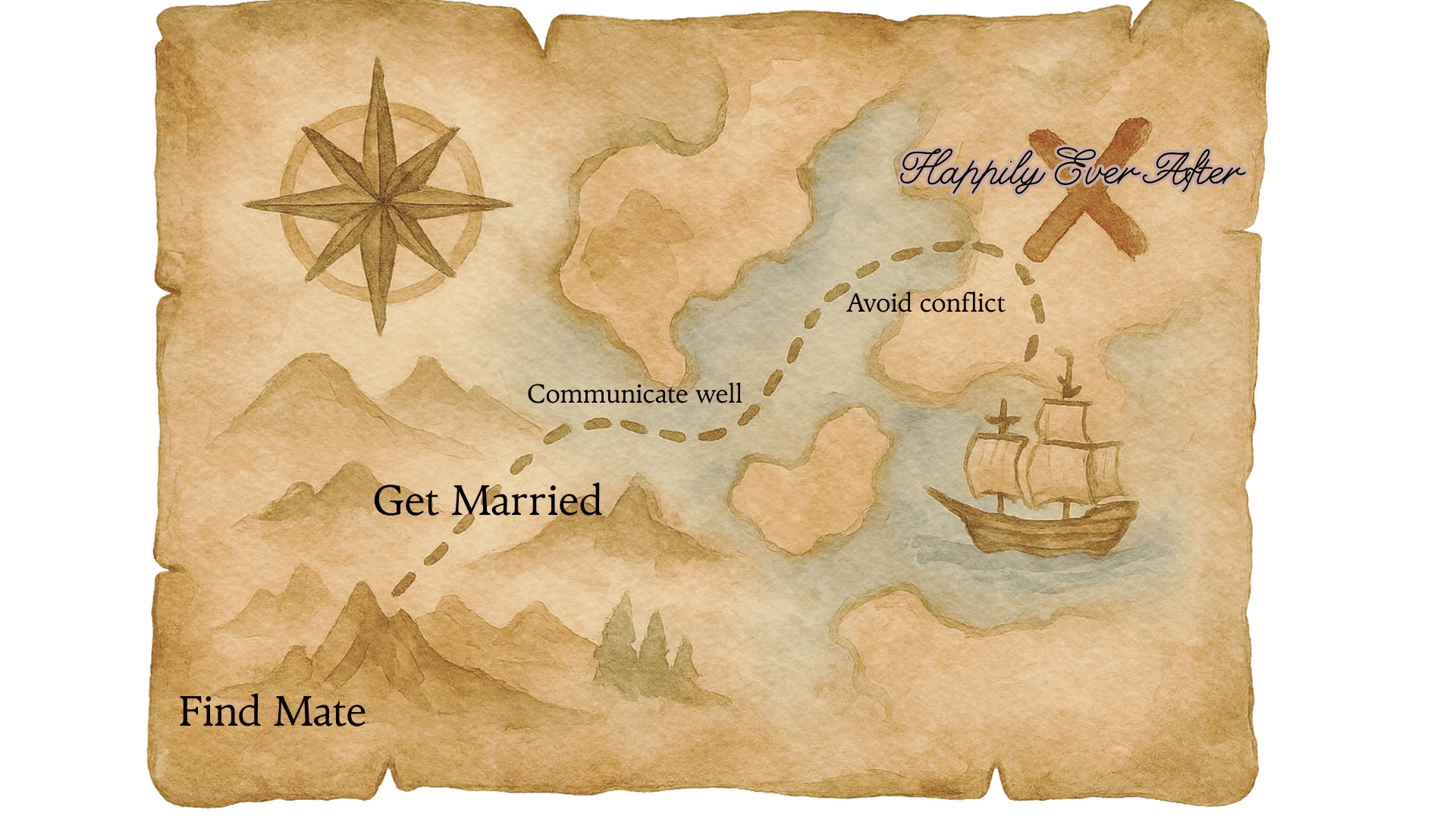
X marks the spot
In terms of bumps in the road, that old map comes with pretty well-established detours:
You will argue about who's right → if the smug high road is taken, try the passive-aggressive bypass to get what you want.
You will negotiate compromises that leave both of you slightly dissatisfied → well, you can drive down resentment road, or simply keep doing it your way, hiding in the caves and tunnels.
You will at some points wonder if you're fundamentally incompatible → take a detour at denial and disassociate avenue, or drive down memory lane (careful, go too far and you’ll bump into the arms of an ex).
This map assumes the destination "happily ever after" is static, and any conflict means you took a wrong turn. It doesn't contain markers (or guidance) for growth.
With this letter, I want to introduce you to a different way of thinking, and invite you to start charting a new map: one where relationship problems aren't signs that something is wrong with you or your partner, but invitations to grow your capacity to stay present and connected under pressure.
The case for growth & development
Being with my man for 20 years now, I’ve come to understand that the bumps in the road aren’t a sign of impending relationship failure, or a challenge to avoid, but a signal that it's time to grow as a person and as a partner.
Story time:
When things started going poorly in my marriage, I spent months reading self-help books and complaining to my friends. I tried various strategies trying to get my man to see things from my perspective, but nothing really worked. I asked him to go see a counselor with me, but he refused. So I went by myself.
Eventually I came to a crossroads: I didn’t like the future I was seeing with him not changing anything, so we had one final conversation where I clearly stated what I wanted and asked if he could give that to me. He said he could not. In a very undramatic and mature conversation, we figured out next steps about moving and money, and I went to spend the night at a friend’s house.

Should I stay or should I go?
When I came back the next day, I found him sitting on the couch. He said, “I get it now”, and agreed to go to counseling together.
Now that I’m a couples coach myself, I see first-hand how common our situation was:
One partner becomes dissatisfied. They try to get the other to change. They seek professional support, often by themselves. The relationship reaches a tipping point.
And while that pattern can lead to growth, it often carries hidden pitfalls. E.g. by saying, “here’s what I need from you," I outsourced my happiness and gave up my agency. By saying "I get it now," he minimized and ignored my unhappiness for months - until there were real consequences for him.
Neither of us was doing harm on purpose. We were just following that old map and didn't know any better.
Here is why most relationship advice still misses the mark:
It treats connection like a problem to solve, rather than a capacity to develop.
It focuses on the “he said, she said” details, rather than the underlying processes and dynamics.
It waits for a crisis instead of supporting growth along the way.
The case for Relational Intelligence
I define relational intelligence as our ability to navigate complexity in intimate relationships (e.g. differences in desire, competing needs, or conflicting emotional patterns) without collapsing into blame, shame, shutdown, or retreat.
If you've ever been around a baby or a toddler, you know that relational intelligence is not something we are born with. Thankfully, it is something we can learn.
Relational intelligence isn’t about saying the right thing, never arguing, or not making any mistakes. It’s about having awareness of what happens for you when things get uncomfortable, and practicing to stay alined with your goals and values.
It’s the difference between feeling a tightness in your chest and going into fight or flight, versus noticing that tightness, taking a breath, and choosing how you want to show up in that moment.
Emotional regulation and differentiation, i.e. understanding yourself as separate from your partner, are vital characteristics of relational intelligence. The main areas for building these capacities are:
Knowing who you are
Knowing what you want and don’t want from a relationship
Communicating kindly and clearly, even when it’s difficult for your partner to hear
Listening with curiosity and compassion when your partner shares something that is difficult for you to hear
One of the maps I use with clients to help them navigate this terrain is the developmental model for healthy couples by Ellyn Bader and Pete Pearson. It shows how most relationships naturally move through stages where closeness, independence, and tension all interact, and how to work through them. You'll hear more about these in upcoming letters.
Another map I love is based on Jung’s understanding of the psyche, which comes to life through personality Type. It helps you recognize your comfort zones and your blind spots, your stressors and your opportunities for growth.
The good news is that relational intelligence is made up of skills that can be practiced. Some of it you can do on your own. Some of the work is deeply relational and best developed with some coaching support. I'll be sharing some DIY exercises in these letters, but please remember you can always reach out if you don't want to do this alone.
Invitation to Journal / Think about
When we're young, the relational maps are simple: there's only good/bad, right/wrong, safe/unsafe. As we develop and start to pay attention, our maps become more nuanced:
There will be deserts where we learn how to hold a paradox.
There will be deep forests where we learn to stay present with discomfort, because we have to move slowly.
There will be steep mountain passes where we learn to see our partner's perspective and our own, without needing one to win and the other to lose.
The thing with old maps is that they are comfortable, and we know how to use them. They may not get us to where we want to go, but at least we don't have to learn a new system.
If you're tired of feeling lost and ready to orient differently, here's a place to begin:
What do you want to be experiencing in your relationship that you're not experiencing now?
Who do you want to become as a partner?
Not what you want or need. Not what you wish your partner would change. What capacity, perspective, or courage do you want to grow in yourself?
If you have any questions or concerns, contact me or share them anonymously here: https://forms.gle/gVeLjikMqDucZEAf6