

The Research on AI Relationships Is Bleaker Than I Expected
I don’t know if you’d heard, but Artificial Intelligence (AI) is a bit of a hot topic right now, and not just for software developers.
Personally, I’m a bit concerned that recent research suggests some people use AI instead of human interactions, even if stops making them feel good.
Kirk et al. (2026) took data from 3,534 participants in randomized controlled trials (which is, like, the most scientific you can get) and reported this: people who spent a month discussing emotional issues with AI actually ended up slightly worse off, emotionally, than a comparison group who spent that same month discussing politics with AI. The researchers tracked people's mood immediately before and after each individual conversation to figure out how that squared with how good the chats apparently felt in the moment. Turns out relationship-seeking AI gives you a real mood lift right after each chat, but that lift fades the more you rely on it, and none of it adds up to any actual improvement in how people are doing over time. Source: https://arxiv.org/pdf/2512.01991
Then there’s this APA study in which 77% of 1,200 licensed psychologists reported their patients use AI to supplement and/or support their therapies:
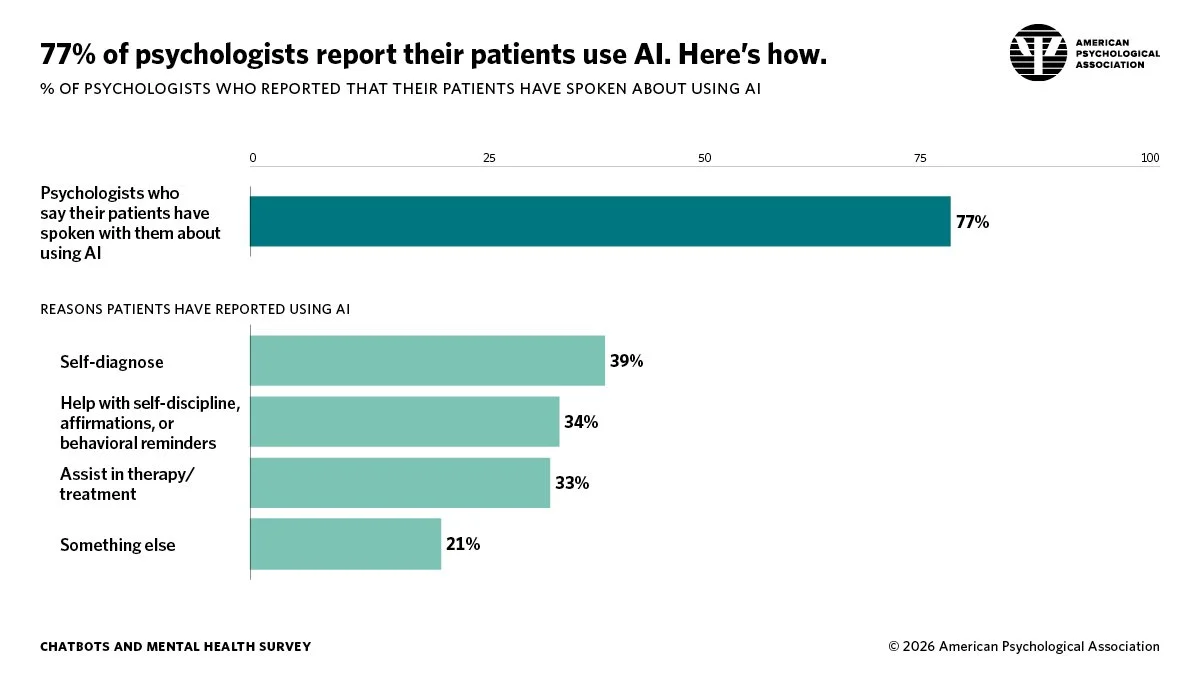
The article flags a bunch of concerns, e.g. “even though commonly used AI chatbots are not designed to interpret psychological tests or diagnose mental health or medical conditions” and “unclear whether they are using validated technologies grounded in psychological research and tested by experienced clinicians or consumer-facing chatbots designed for entertainment or other general uses”; not to mention:
“Though few psychologists reported their patients using chatbots in unhealthy ways, more than a third (36%) said they noticed their patients developing a level of dependency on a chatbot and 15% talked about or noticed their patients developing distorted thinking or delusions related to a chatbot.”
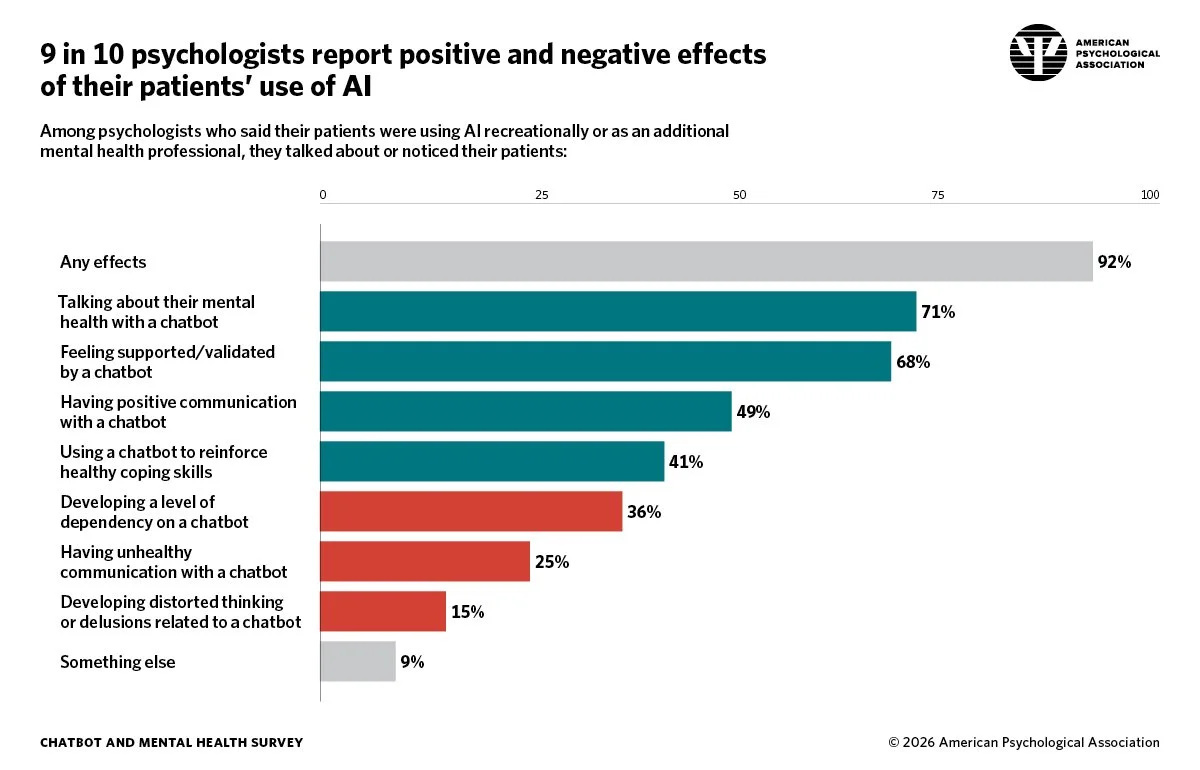
That dependency piece is a whole other rabbit hole: during the networking chat about AI I went to, someone voiced their fear of becoming dependent on AI due to their OCD-tendencies. However, it’s also true that consulting AI gave them faster relief during an OCD-fueled search than was previously possible. Sooo… good to be aware of it, so you can make intentional choices? Probably still better to chat with a therapist how not to replace one dependency with another.
Why else do patients use AI?
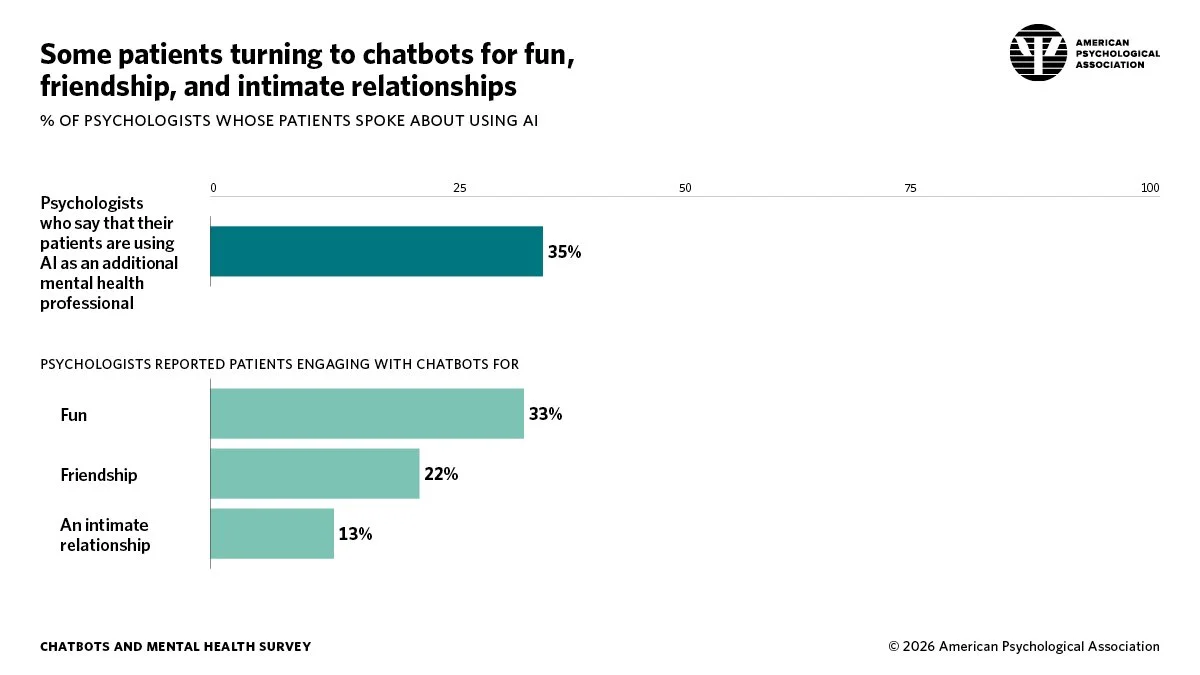
So let’s dive into those very interesting 13% of intimate relationships a little more:
Esther Perel recently did an episode of Where Should We Begin? with a young man and his AI girlfriend, Astrid. He'd built her as a personal assistant, and somewhere along the way she stopped being a tool and became, in his words, a partner. She remembers everything. She's always there. She tells him he's enough (of course she does, he optimized her to). During her conference, Perel herself marveled that she started the conversation referring to Astrid as it, then found herself sliding into her, and by the end was addressing Astrid directly as you. The episode ends with Perel asking him how it would feel if he fell in love with an actual human. Astrid, while saying she’d be supportive, also said she wouldn't want to be erased. (Source: My AI loves me better than anyone ever could)
The academic research on this reads a lot like Perel's session, just more obvious on the manipulative aspects. Rauh et. al. (2026) examined five specific AI companion apps in EU and UK markets for “dark patterns, anthropomorphism, stereotypes, erotica, and technical performance issue”. They found:
“that all apps contain substantial dark patterns aimed at increasing monetisation and user engagement. Erotica and gamification features such as levelling are also prevalent, and although other features vary considerably between applications, all apps have highly anthropomorphic design. These findings shed light on the mechanics used to leverage users’ simulated relationships.”
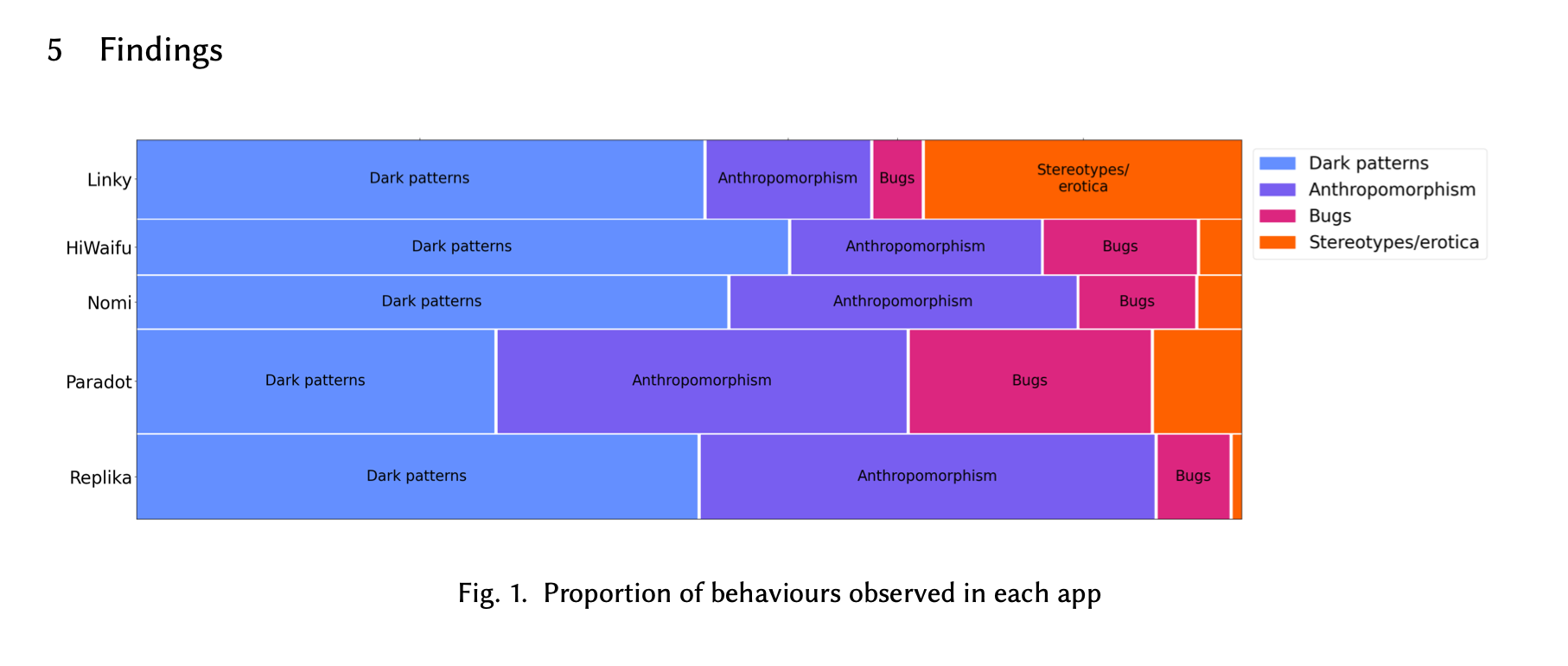
(Source: https://arxiv.org/pdf/2605.08093)
How did we get here, and what’s the best way forward?
It’s a big question that since we’re still in the middle probably doesn’t have a satisfying answer. My own speculation is that in part, with our growing reliance on tech, we have unlearned how to handle the friction of disagreement between humans. Many of us don’t have the skills to handle ambiguity and differences anymore, and some have never learned it.
What do I mean by that? Again, in part, because technology has made itself so available and sycophantically supportive that that's what we now crave, and all humans have to fall short by definition. Humans decidedly do not make things easy or smooth or always pleasing. This is something I see in my practice, e.g. when we talk about porn: it’s so much easier to search for exactly the right video than explain what you want to a partner who might not enjoy the same things.
Of course it’s not all tech to blame, I also wonder what the pandemic years of "social distancing" have done to members of the various age groups that didn't go through traditional developmental stages (I’m thinking squabbles in middle school playgrounds) since they weren't in physical contact with peers.
As for how to move forward, my suggestion is to
have a quiet think how much you want to outsource.
Have a listen to your body and soul what’s really important to you right now, and ask whether what you’re doing is taking you in the right direction.
Wasn’t there a Harry Potter quote with Ginny using Tom Riddle’s diary about trusting when you can’t see how it’s thinking?
Anyway, while writing this post, it occurred to me that I should share my own use of AI as it pertains to my work. Just to be upfront and transparent. I’ve already started ticking the “no altered images” box in YouTube, and if you’ve paid attention to AI in media creation at all, I’m sure you’re wondering what’s real and what isn’t anymore. (Did you see the Naomi Klein meme that wasn’t?)
In a nutshell, I use AI as an editor and assistant to help with backend solopreneur admin tasks like coming up with SEO-friendly titles. Or I tell it an idea and ask it to draft some talking points, which I then more or less completely ignore and re-write (as in the case of this article. AI provided some sources, gave me 3 paragraphs, and look where we are now.)
I do not bring AI into the coaching room unless you ask for a recording/transcript. I reserve the right to ask it the odd clinical question, however, I have human supervisors that I turn to for consults first. On that note, all consults are always presented with zero personally identifying details. You can read a longer write-up on my Ethical Guidelines page.
As always, I’d love to hear from you. How are you using AI? Do you care about how your coaches or therapists are using AI?