

Why Desire Dwindles in Long-Term Relationships
I attended Esther Perel’s conference a few weeks ago, and am slowly looking through my notes for goodies to share with you. One of the presenters and panelists was Dené Logan, who I’d already studied with during my Embody Lab certification. She takes a depth approach I really resonate with, so I figured you might, too.
Here are my notes and thoughts from her session:
“You belong to me: Why desire dwindles with deeper commitment.”
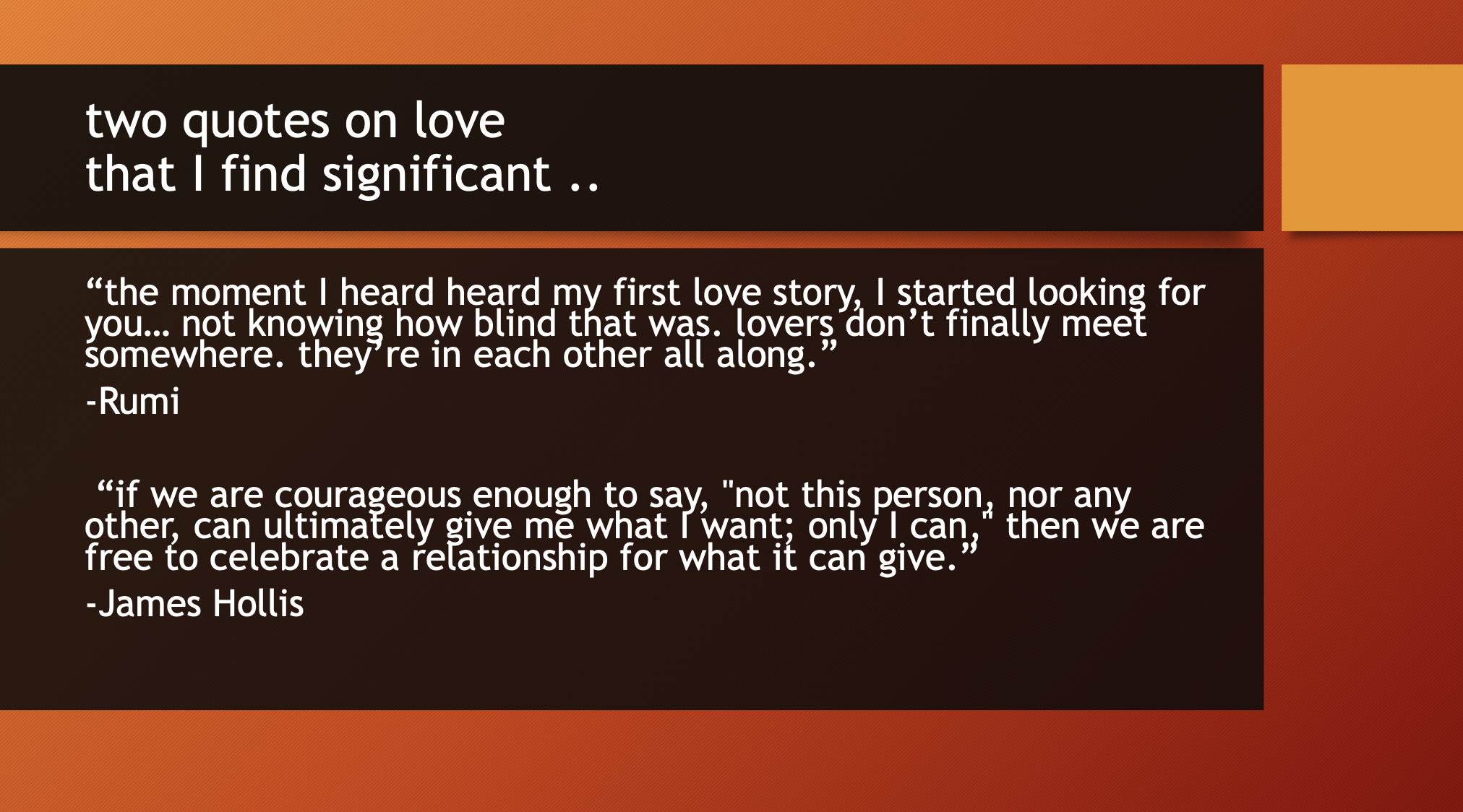
She opened with two quotes:
(C) Dené Logan
and used them to reframe what it means to collide with another person. What if there's an intelligence to who we end up across from? What if the person irritating you right now is doing exactly what they're here to do?
That shift, from expectation to celebration, is kind of the whole talk in one sentence, and inspired my post about choosing your spouse.
“MY husband.”
Dené talked about how modern relationship structures are still running on a template that was, historically, literally about property. Women in the US couldn't have their own bank accounts until 1974, so getting married was a transfer of ownership from your father to your husband. Our internal script hasn't updated anywhere near as fast as cultural conditions have.
She compared it to a new dress. You know how it is. You get the dress, you love the dress, you wear it five times. And then: Oh. That old thing. That's what tends to happen after we've "got" someone.
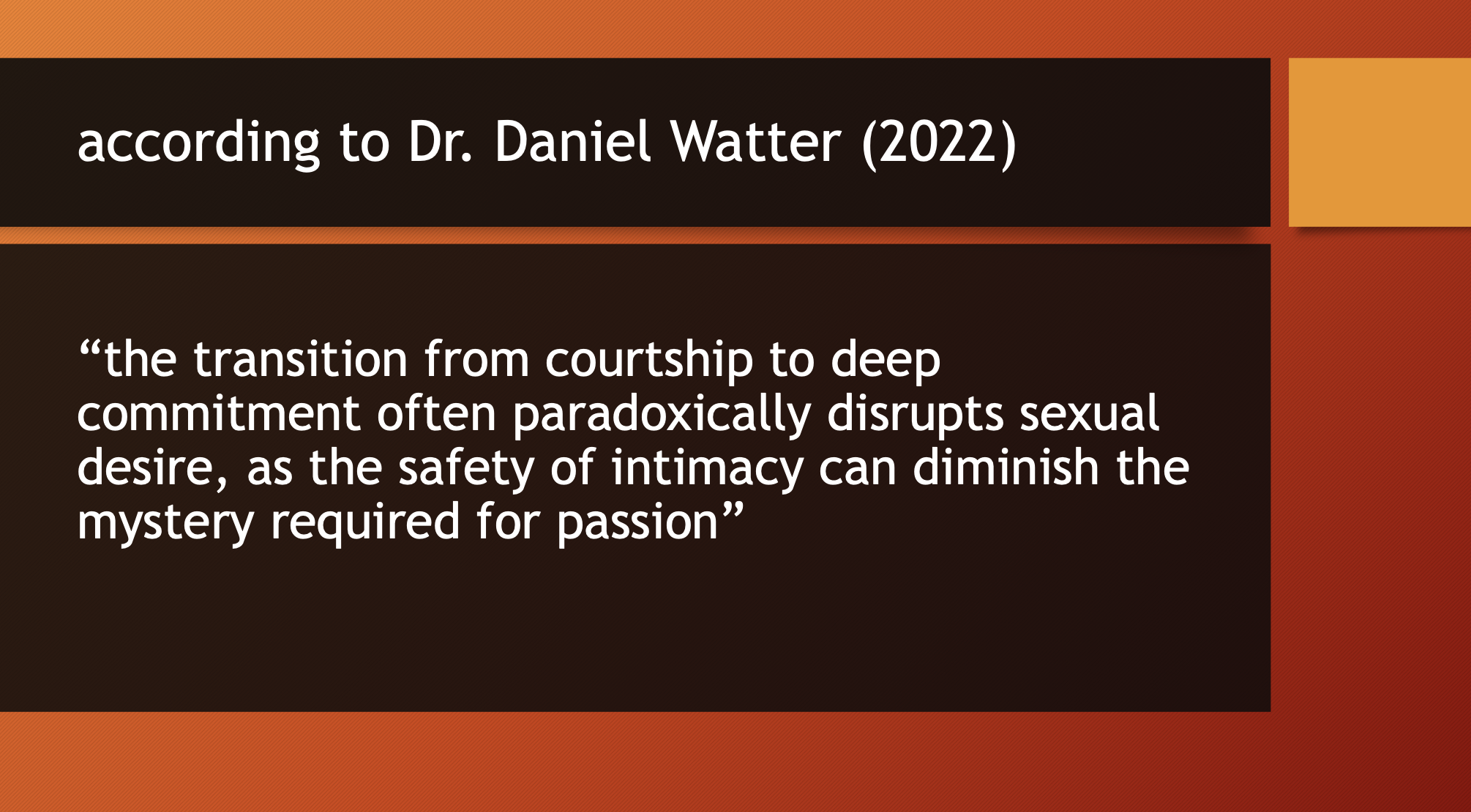
The desire piece is where she relies on Esther Perel’s vocabulary (of course, we’re celebrating “Mating in Captivity”’s 20th anniversary.
“The verb for love is to have. The verb for desire is to want.”
And it's genuinely hard to want what already belongs to you. Desire tends to need distance, otherness, a little mystery. We're drawn to our partners when we see them doing something we haven't seen before, when they’re in their element, when they're briefly a stranger again, when we're reminded that they are a whole other person out there in the world.
There's so much in relational psychology that optimises for closeness, security, and attachment. And yes, we need those things. But to Dené's point, we've underinvested in the other side of the equation: The aliveness, autonomy, and the part that keeps two people actually interested in each other. (This enmeshment piece is something Ellyn Bader and Pete Pearson from The Couples Institute also defined in her developmental model; they call it the symbiotic stage.)
(C) Dené Logan
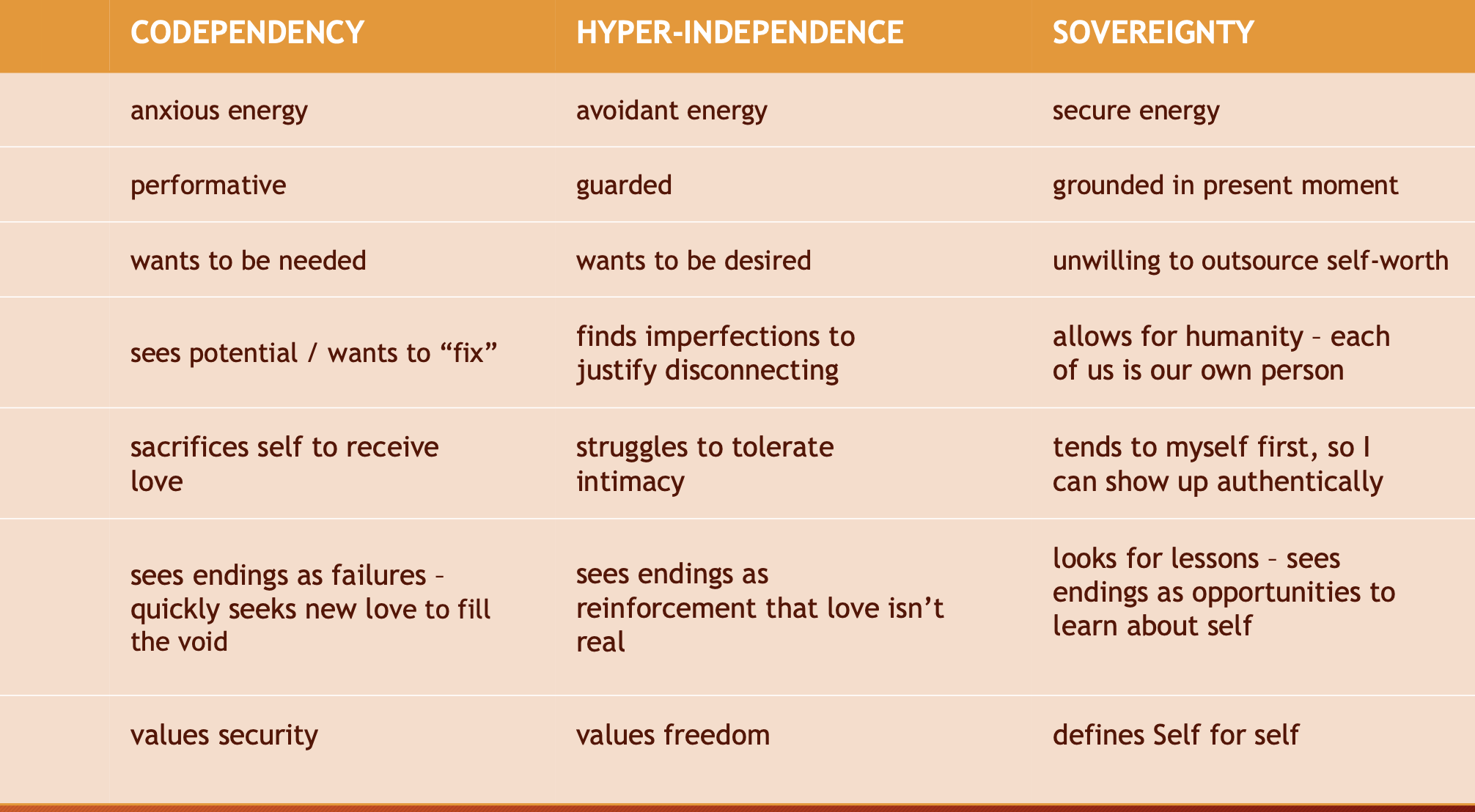
Dené then described three relational energies rather than fixed styles: codependent, hyper-independent, and sovereign. Codependent energy is the anxious mode, the who do you need me to be, I'll be that, just please stay. Hyper-independence is the avoidant overcorrection, the I don't need anyone, everybody back up. And sovereignty is the ongoing practice of returning to a secure sense of self. She was clear this isn't a state you arrive at. Nobody lives there all the time. It's more like a direction you keep orienting towards. (In the Bader-Pearson model, this would be differentiation, which Dené also mentioned.)
Her definition of love is this: "Loving another person means your soul is safe with me." Not: I'll make you comfortable. Not: we'll stay together no matter what and call that success. But: I won't interfere with what you came here to learn. I'll witness you becoming the person you're meant to be. Even if at some point that means our paths need to change form.
That's a reframe that goes against almost everything we've been taught about what a successful relationship looks like: how long it lasts. Also, not gonna lie, a part of me kind of reacted to her coolly throwing out terms like “soul” and “sacred,” so I know I have some work to do around embracing the spiritual nature of love.
(C) Dené Logan
She also talked about the Jungian individuation process, which I find endlessly interesting, this idea that we're supposed to keep becoming more fully ourselves, shedding the persona, doing the shadow work. And that what our partner tends to activate in us is less about them and more about whatever's still unfinished in us. Two people's triggered inner children fighting to be seen isn't a relationship problem, it's just what happens when humans get close. The work is in learning to bring your inner adult to the conversation. (IFS does this beautifully.)
A few things she mentioned that I might carry into my own practice:
The impermanence meditation. She says she meditates daily on the possibility of losing her partner. Not morbidly. As a way of practicing gratitude rather than entitlement. If this person weren't promised to me, how would I hold them?
The wider toolkit. Your partner can't be the only place you go for regulation. Community, nature, spirituality. “Fire needs air,” as Perel says. You can't feed desire and enmeshment from the same source.
And ritual. Just ritual. Something daily that brings you back into your body and back into the sacred. For her it's stillness and movement. For couples she recommends something simple: speaking out loud, every day, why this person is sacred to you. (I made a video about micro-rituals here: )
The question she left me with, not her words exactly but the feeling underneath all of them: are you relating from the premise that your partner owes you something, or from the premise that they are a gift?