

How ENFJs and ESFPs Love Differently (And Why)
If you’re in an ENFJ-ESFP relationship, it’s easy to feel disconnected or boxed in. This post will break down the clearest—and the sneakiest—differences between ENFJs and ESFPs... so you stop misunderstanding each other, and finally start clicking.
To help us understand why ENFJ and ESFP can look and feel so similar yet so different, we’re going to look through three specific lenses:
How do they like to interact with others, and how are their energies different? (plus a juicy communication insight)
What are their deep-seated psychological needs and essential motivations for their behavior? (plus a surprising focus they have in common)
How do their brains process and make meaning of life? (plus a coaching suggestion nobody asked for)
If you’re new here, welcome, my name is Doris, I’m a certified type and intimacy coach with a Masters in Psychology, and I help smart romantics build meaningful relationships. (If you prefer to watch this as a video, you can do so here.)
Interaction Styles(TM)
Interaction Styles(TM) looks at the energy we bring to our social interactions, and it is often a visible marker for how we do what we do. This model is one of Dr. Linda Berens’ ones that make up her Integral Type(TM) approach, in which I was certified back in 2012 when it was still called CORE. (And then I went through it again in 2019 and 2020 and my point is, with Type, you will always learn something you hadn’t seen before, and things just keep clicking in different ways, it’s amazing.)
People with ENFJ preferences are in the “In Charge” group.
People with an In-Charge(TM) interaction style like to
position themselves on top or out front.
they have a pressing drive to accomplish things and get achievable results
To do that they make quick decisions and act quickly, so they can move on to ticking the next thing off their list. (i.e. next accomplishment)
The downside to quick decisions of course is that sometimes, if you don’t think them through, decisions have unintended consequences.
But people with an In-Charge style tend to have a lot of confidence that they know what is needed.
and they want to control resources and remove obstacles. ENFJs especially like to mentor others, so they’re good at spotting talent and then nurturing and encouraging that talent.
What does this Interaction Style look like?
Their energy is determined.
It’s the kind of energy we can all get to when we’re running late or hurrying to get somewhere.
The core belief is it’s worth the risk to go ahead and act or decide, and we tend to appear energetic, confident, composed, in control, commanding, sociable, straightforward, and decisive
People with ESFP preferences are in the “Get-Things-Going” group.
People with a Get-Things-Going(TM) interaction style
have a drive to involve others and be involved, so they move around a lot
They have a pressing drive to get everyone involved and participating
To do that they facilitate and encourage the maximum amount of interaction to be sure everyone’s opinions and viewpoints are included
All of these efforts help arrive at consensual and collaborative decisions where people are aligned with the outcome
The downside of this decision-making style is that it can take a great deal of time, and for smaller decisions the effort may not be warranted
But people with a Get-Things-Going style want to get an embraced or collaborative result, and it isn’t good enough for people to agree to do something, they’ve got to want to do it. So people of this style recognize the value of buy-in and help discover new ways of seeing things to give the group they’re in even more involvement
What does this Interaction Style look like?
Their energy is engaging. This kind of energy we can all get to when we’re looking forward to meet someone we haven’t seen in a while; aka Tigger walk.
The core belief is that it’s worth the energy to involve everyone and get them to want to
And they tend to appear energetic, animated, expressive, enthusiastic, engaging, gregarious, persuasive, and their decision-making is consensual.
If you’re an ENFJ, you might be thinking,
“hang on, there’s no way I’m “In Charge”, they sound kinda bossy and controlling, but I’m all warm and lovely and fluffy over here! Get Things Going sounds so much friendlier, shouldn’t I be in that group?”
let me ask you this - how long can you be all warm and fluffy before you lose your patience and just need people to get stuff done?
Since I have ENFJ preferences myself, let me just say that yes, we’re in the kinda bossy group, and yes, the other one sounds a lot nicer, AND that’s really confusing because we’re one of the kindest and most empathetic types around!
But when it comes to our energy and how we like to interact with others and get things done, even though we might not feel particularly confident on the inside, our vibe is. Think about it, we are calm under pressure, because that’s where we shine. We can deal with and handle a lot, which is why sometimes people follow our lead even when we’re not the ones actually in charge.
Maybe this next example will also help clear it up.
The Interaction Styles model offers a big insight into how we communicate that is not covered in the usual Sensing vs Intuiting debate: people with an In-Charge style prefer directing communication, and people with a Get-Things-Going style prefer informing communication.
What does that mean? Well, when you’re trying to get someone to do something, do you tell them straight on, or are you more circumspect?
Consider this example: A son walks into the kitchen. The father stands by the fridge and says, “hey son, we’re out of milk.” The son replies, “that’s ok, I’ll drink orange juice.” Something in this exchange didn’t hit the mark, but what was it?
In this example, the Dad is informing the son, hoping he’ll get the hint, to go out and buy milk. But the son has a directing communication style, so he’s not likely to pick up on that kind of subtle information, because that’s not how he would ask. Remember, we tend to assume people are like us, because our way is obviously the best, because otherwise we wouldn’t be doing it, right?
So the son would come right out and say, “hey dad, next time you go shopping please get some milk, we’re out.” Or the other way around, if the Dad had said, “hey son, we’re out of milk, please hop on yer bike and go to the store” maybe the son could have been like, “cool, will do.” (Or maybe he’d be a teenager about it, but that’s another story.)
As an ENFJ myself, I tend to think I’m all sweetness and light when I talk with others, but the truth is I can be pretty direct. And that’s not just because I was raised in Germany by an ESTJ mother, it’s also because I don’t like to backtrack or repeat myself. Most blog posts I write or videos I script are the first draft with minimal editing and done, next.
When it comes to convincing others or moving towards a goal, I center people, values, and feelings, but I also focus on time quite a bit. So even when my word choice is diplomatic, the energy behind the words that come out is pretty clear - because that is what supports my Interaction Style’s innate drive to accomplish things, to get things done, to tick things off my list.
Unfortunately, when it comes to romantic adult relationships, this can backfire because my partner is not some project I need to micro-manage.
For people with ESFP preferences or the Get-Things-Going style, a more informing approach to communication best serves their innate drive to involve others and get them on board to want to do the thing, or move toward the goal. Instead of telling others what would be best to do in the long run first, the ESFP would rather be laying out the pros and cons and giving others a chance to make up their own minds and buying in. That takes a lot longer than the ENFJ’s direct approach, and if your partner sees where you’re going it can feel highly manipulative (”why didn’t you just come out and say that!”), but for complicated or complex issues involving multiple people, it’s usually pretty effective.
So to recap part 1, ENFJs have an in-charge determined energy that likes to get things done, and they don’t shy away from telling people what they want them to do, straight on. ESFPs have a get-things-going engaging energy that likes to involve and be involved, and they prefer to be less direct and for others to be less direct with them.
This next lens holds a clue into why that might be.
2. Essential Motivators(TM)
Essential Motivators is a continuation of David Keirsey’s Temperament theory, but Linda calls the NF types Catalysts, and the SP types are Improvisers.
Let’s start with the Improvisers. You can find these in Linda’s green book.
The essential motivator patterns are presented in the form of these targets, or tree rings, if you will.
Behaviors are visible elements for each pattern CLICK Talents are the gifts we’re given to scratch the itch the core needs create
Values are closely entwined with our needs, and they inform how we view the world. They’re not always easy to communicate if we don’t have the language, and they may be different from cultural or societal values we grow up in.
Needs are often unknown to us, but these are what each pattern needs to feel psychologically alive. As Jung would say, if you ignore or can’t meet your psyche’s needs, you will likely develop a neurosis.
People who have an improviser pattern are really tuned into changes in situations or people’s expressions and opportunities for action.
Improvisers find it painful to not be free to respond to the moment, because they trust their impulses, and they feel incredibly stressed when they feel constricted or when they are restricted from acting or reacting in the moment. They are also so perceptive that they notice so many things.
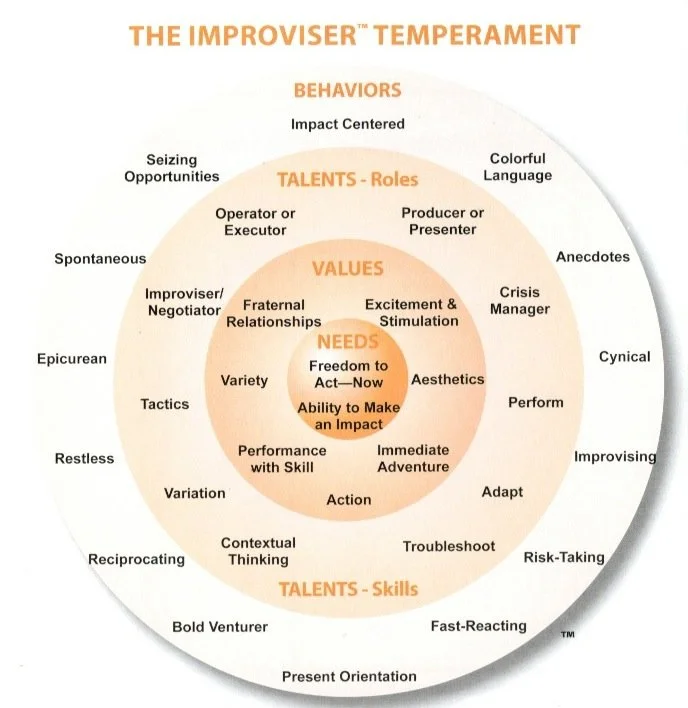
From Understanding Yourself and Others - Exploring Essential Motivators(TM) by Linda Berens, available for purchase here: https://www.interstrengthinstitute.org/collections/online-books?q=
Many of us want to have an impact, and many of us need to feel free, but for improvisers, the need to see a result from the action or elicit an immediate response from others is stronger and more tangible.
This need for a response and impact ties into their drive for action, immediacy, and orientation to the present moment.
In his EEG research, Dario described this as the tennis-hop pattern, where extraverted Sensing brains, are ready to respond to various stimuli in the blink of an eye.
Improvisers are often found in Operator / executor roles, so they might run a business, troubleshoot problems, train others, operate machinery or equipment - any kind of executing that makes sure things happen. CLICK Producer / presenter roles are more informative and allow improvisers to create variations on a theme. They produce or present something that has impact and that gets people responding.
The cynical side of improvisers is their astute ability to recognize that people do things for their own benefit, this can be a healthy cynicism or veer off into distrustful, but for most, it means they accept others without judgment.
People with a Catalyst pattern are forever in search of the answer to the question, who am I. They want to be unique, and they want to be loved for who they are, not for what they produce. In a relationship, we like to know why we’re important to our partners.
Many of us want to feel appreciated, and many of us want to fulfill a purpose, but for Catalysts, the need to live a deeply meaningful life, aligned with personal and or societal values is stronger and more tangible.
Catalysts ALSO think about humanity on a larger scale and need a sense of being a part of something greater than themselves. They would love their lives to be significant, and they look for meaning in everything. They’re very much the idealists of this world, so they’re always considering what could be, and have a future orientation that way.
They thrive on empathic relationships and are the kind of people who will praise, champion, cheerlead, and support others.
Catalysts are often found in these Mentor / Foreseer roles, so they might be teaching, coaching, inspiring, or helping others live their best lives.
Harmonizer / Advocate roles speak to the catalysts love for peace and equality, and support them to explore their natural gifts for empathy, diplomacy, and creating connections.
People with catalyst pattern are usually optimistic, they believe in the best in everyone, and, well, sometimes that can make them quite gullible, so they get taken advantage of.
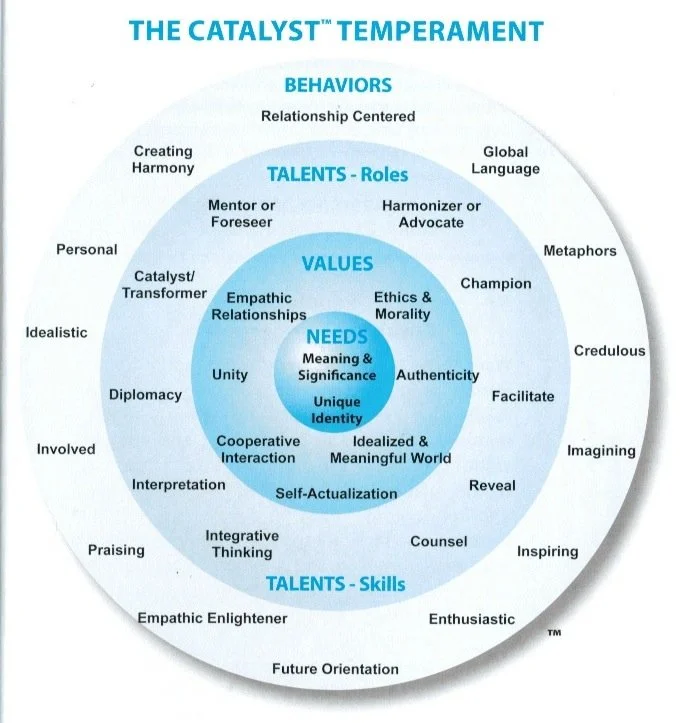
From Understanding Yourself and Others - Exploring Essential Motivators(TM) by Linda Berens, available for purchase here: https://www.interstrengthinstitute.org/collections/online-books?q=
Imagine an ENFJ and ESFP couple go out to a party together. The ENFJ is hoping for a little more of her ESFP partner’s undivided attention. I think this model shows quite nicely how the Catalyst blooms and her heart and mind opens when connection feels deep and meaningful, and the Improviser heart and mind bloom open when connection feels exciting and spontaneous.
I wouldn’t be surprised if the ESFP is actually trying to connect by pointing out all the exciting things or people they’re noticing, in an effort to involve their partner and bring them into their vibrant buzzing world. It’s not about ignoring them or avoiding anything deep, rather it’s having the freedom to enjoy connecting through sharing all the experiences of this present moment, and this one, and then this one.
Now, Catalysts also tend to focus on what we all have in common, so since we looked at how communication between in-charge ENFJ and get-things-going ESFP can be quite different, I’m going to add that both catalysts and improvisers have a motive focus.
In other words, they pay attention to why people do things. A motive focus helps us get a sense of what’s really going on, and there’s a real curiosity behind understanding “what’s in it” for the other person. When trying to understand others, this motive focus helps Catalysts and Improvisers improve how they relate to one another.
So, you didn’t ask for coaching but maybe this is helpful for someone else watching the video as well: if you the ENFJ want to encourage your ESFP partner to pay a little more deeper attention to you when you’re out and about, even though you might be asking for it quite directly, using our kind of abstract symbolic N language “I want us to be more connected!” is probably not going to land or get much traction. Instead, you might say something like this:
“I love how much you enjoy the buzz of everything around us. But when we’re out, I sometimes need a little more of your attention to help me feel special. I feel most connected when we carve out a few little moments just the two of us. Can we try making more eye contact or having a couple of extra check-ins? That would really help me feel more grounded and like we’re in the fun together.”
You’re validating and celebrating their amazing Improviser buzz, you’re keeping it sensory-specific with moments of eye contact, and you’re explaining why it’s important to you. Obviously feel free to adapt, if your preferred sensory focus is more touch-based than instead of eye contact make it a hug or a make-out session, right? Feel free to customize to your needs.
To recap part 2, ENFJs are deeply motivated by meaning, purpose, unique identity, and belonging. They are Catalysts with a future focus. ESFPs are deeply motivated by the freedom to act NOW and the ability to have an impact. They are Improvisers with a present focus. Both are interested in people’s motivations.
3. Cognitive Functions
Jung’s personality theory identified four main ways we use our brains, two to process information, two to make decisions. They are Sensing, Intuiting, Thinking and Feeling. All four can be expressed in an extraverted or introverted attitude, giving us eight cognitive functions.
Everyone has access to all functions, but they show up in a different order for each type.
ENFJs lead with extraverted Feeling (Fe), which hits ESFP’s in their 6th position.
For ESFPs, the dominant function is extraverted Sensing (Se), which is 3rd for ENFJs.
Each of these positions has different archetypal energies attached to it, and to explain how that changes how the function shows up, let’s look at excerpts from Linda’s blue book about cognitive dynamics. Again, I recommend you get the red, green, blue bundle here.
This is not the whole thing, but in the lead position for an ENFJ, Fe looks like this:
“They approach life by continually tuning in to the needs, wants, and desires of others and keying in on ways to help people grow and develop. Generally comfortable themselves in a wide range of interpersonal situations, they seem to know just what to say to people to make them feel worthy and okay about difficult situations. They take pride in creating a space where others can do their best and develop to their full potential. (…) Since Fe is often the process that is most trusted, they may engage in it too much and then use it in a dominating way. They can become overbearing in their assumptions about what others need and how they are feeling. Often feeling responsible to take care of others’ feelings, they may lose themselves in the process of empathizing with what someone says and how much it means to them.”
From personal experience, especially once you hit your later 40s, that’ll probably ease up and boundaries become your friend. But it’s a great overview how our minds work - the thing we can’t not do is connecting and considering others and the larger group.
For an ESFP, Fe is in the 6th, so in shadow, or below the conscious access waterline. This position is also known as the “bad parent”, so whatever harmonizing we ENFJ’s are doing naturally, it can seem like criticism to an ESFP, or like we’re being judgmental.
So when it comes to connecting and considering others and the group for an ESFP, Linda writes:
“They can become quite critical and disgruntled about the expectations and norms of the group to the point of completely disengaging and even rebelling. Yet at times they can magically connect with the group and move it to a new place.”
And their get things going interaction style helps with that.
But generally speaking, where we ENFJs like sticking to societal norms because we think that’s how we can make sure people are safe and treated fairly, it can land as trying to impose rules to an ESFP. Remember, improvisers have a deep psychological need for freedom, and rules don’t feel good, so unless they make sense they will get ignored.
It’ll become even clearer when we look at the ESFP’s lead function.
In the lead position, extraverted Sensing or Se looks like this:
“They experience life to its fullest, being incredibly present in the moment. They are tuned in to minimal non-verbal cues of what is going on with peple. Their minds are continuously noticing and scanning for reactions and relevant data. Getting in sync physically with people and the things around them usually comes naturally to them. They enjoy the thrill of action and physical experiences in the present moment. (…) Since Se is often their most trusted process, they may engage in it too much. They may over-indulge the senses, insist on getting a lot of data, or proceed only with what they have at the moment. As a result, they may repeat the same experiences over and over, eventually finding themselves limited and bored.”
So, the thing ESFP brains can’t not do is experiencing and acting in the immediate context.
For an ENFJ, Se is in the 3rd position. That means we have quite good conscious access, but it’s also where we’re a bit uncertain and are looking for validation. Beebe calls it our eternal child, so doing Se stuff is usually fun and relaxing, but we can’t do it well for long. So compared to someone who’s super good at doing it naturally, we can feel not good enough by comparison, and we like to be the best at things because then people will like us and we will have meaning and be special, so comparisons are always an issue.
So how does extraverted Sensing get expressed in ENFJs? Here’s how Linda puts it,
“Often they enjoy the tangible pleasures in life and may have a keen appreciation of how things look, feel, smell, and taste. Orienting quickly to others, they easily get in sync physically with people and things around them. When younger, they tend not to care much about the physical world except to please others and engage in group activity. (Also) Engaging in extraverted Sensing can be unsettling and disruptive at times. They can become distracted by irrelevant happenings around them and bring them up in conversation. They can waste time and resources on indulging their senses or preserving a youthful image.”
Speaking for myself, the older I get, the more overwhelmed I get by outside stimulation, especially auditory and visual. I used to go dancing all the time, now too many people talking in a restaurant make me cranky.
In my personal opinion, I can imagine how in a relationship, I might be judging my own capacity when going out with a partner who is not only in the moment all the time, but also has great vibes about it. Because then I’d be worrying about not being able to keep up with them, which might spiral into “oh but what if they don’t like me anymore? And if I don’t want to go out anymore, then the whole relationship connection might be threatened.” But yes, this might be my Fe empathizing or overusing it, let me know.
To recap part 3, ENFJs lead with the same process ESFP’s may experience as criticism, and ESFP’s lead with the same process ENFJs may experience as exhausting.
Ok, I think we’ve surfaced a lot of evidence that nobody is trying to annoy anyone on purpose, it’s just our brains are wired differently. I hope you now have rich room for conversation and making explicit agreements about how to handle situations like being out and about together in a way that works for both partners!
Which pairing should I look at next? Leave a comment below!
PS: Interested in something more tailored to you and your relationship, but not ready for coaching? I'd still love to support you! Here are some resources you might find helpful:
🎥 Your Core Type -> Self-Discovery Video ($47)