

Two Tools for Better Communication
1. The Johari Window
In the 1950’s, Joseph Luft and Harrington Ingham developed a simple and powerful model to explain feedback and insights. It’s called the Johari Window.
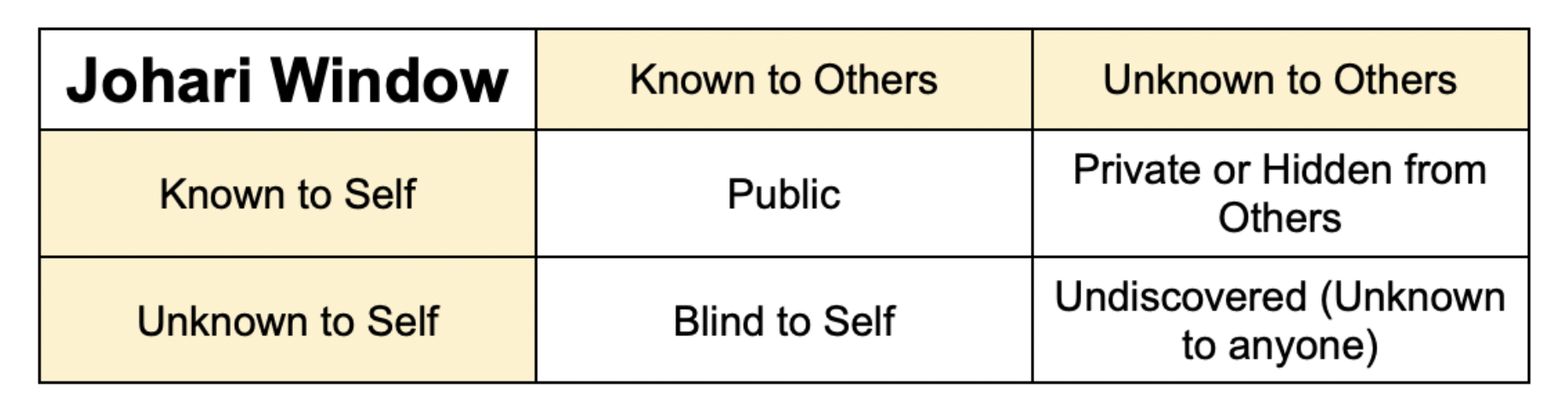
The Johari Window shows how everyone has four aspects:
The “Public” aspect is what you and your partner know. This could be what you look like, your job, and other easily discovered things about you.
When you first met your partner, your "Public" square is probably smaller than your "Private" square.The longer you know one another and the more you share, the larger the "Public" square becomes for your pairing.
The “Private” part of yourself is that which you know but others don’t.
Some people keep this part very well hidden. Not wanting others to know things about you is great for novels, but not so helpful to establish trust in relationships.
The “Blind” part of you is what others know about you, but you haven’t discovered yet.
Your partner may have a better awareness of what your gifts and weaknesses are than you do. As you become more self-aware and learn to trust their insights, their feedback (whether you like it or not) will help shrink this square for you.
The “Undiscovered” are the hidden qualities that neither of you know.
Many "undiscovered" qualities come to light during relationships, as this person close to you pushes buttons you have so far been able to ignore. When that happens, it's time to sit down, explore, and talk about it, using the second tool described below.
With loving partners, feedback is offered as a gift.
What you learn about each other can bring you closer together. You can become comfortable with each other because you accept and trust each other.
Your partner isn't a mind reader. Maybe you're expecting them to know things from your "Private" square that you haven't shared yet.
2. Reflective Listening
We've talked about different communication styles over the last few weeks.
When you combine those differences with being in a hurry or addressing an emotional situation, misunderstandings can cause hurt feelings and challenges in relationships.
When speaking to each other, especially about emotionally sensitive issues, you want to create the best environment for understanding.
Once you’re both in a peaceful place, have reminded yourselves that the person you love is across from you, and are ready to understand, you begin.
The process is deceptively simple:
Who goes first? When both of you want to speak first, flip a coin to decide who will begin.
The first person says what’s on their mind. Say what you want as clearly and calmly as possible.
Look at your partner while speaking.
The second person then reflects back what they heard. You state what your partner said in your own words.
Listen for the feelings behind what your partner is saying.
The first person either agrees with their partner’s interpretation or says that wasn’t what was meant. Rephrase your thoughts and repeat the process.
Keep repeating the process until the speaker agrees that the listener understands what the speaker was saying.
The other person then gives their response and the process is repeated.
In reflective listening you learn about each other.
You hear the thoughts and feelings without your own interpretation interfering with the message. As you gain experience, you’ll spend less time rephrasing your thoughts because you understand each other more easily.
Set some time aside each week to communicate with each other using Reflective Listening. You’ll especially want to use this process when you feel misunderstood or you’re having a challenging time with your relationship.
A Reflective Listening Example
Terry: You’re gone so often I don’t think you care for me anymore.
Casey: You’re mad because I have to work late.
Terry: No, I’m not mad. I’m hurt because you don’t act like I’m important to you.
Casey: You’re hurt because I spend so much time working and that makes you think you’re not important to me.
Terry: Yes, I miss being with you.
It’s easy to misunderstand each other. Take time each week to sit with each other and practice Reflective Listening. This way you can be sure you’re understanding your partner’s words and feelings.
Next week, we'll start talking about how to communicate anger. Stay tuned.
Reflection
Recall a disagreement you’ve had which would have been resolved more quickly through Reflective Listening. Rewrite the conversation using Reflective Listening steps.
Practice taking deep breaths and focusing on the center of your chest. Write about your experience.
List one challenge with your partner that Reflective Listening would help resolve.