

Type & Money in Relationships
Marriage used to be about combining two families' assets. Romantic love as a cultural concept and reason for marriage has only been around for less than 300 years. Still, while you may be committing to one another's hearts and souls, your wallets (and legacies) are also involved.
To be very clear, I am not a financial planner, and you are responsible for how you spend your money.
But let's look at how your Personality Type patterns may predispose you to handling it.
Here is something I heard at a business conference a few years ago: your ideas about money have been created in your minds before you were 10 years old.Like most other things, you learn to think about money from your parents, and now is a good time to revisit those ideas and add your own adult perspective.
Which of these "money types" best describes you?
Avoider / dreamer
Unclear about bills that come in, or what has to be paid by when
Unclear about money coming in and going out
Generally don’t understand the relationship between money and what to do to get what they want
There may even be an aspect of magical manifestation thinking
If this is you, part of your learning process is understanding that numbers are just information, not a judgment on who you are or where you’re going. You probably learned this in your family, so as a kid it made sense and served a purpose. But now you’re grown up with responsibilities.
Think of a thermometer. It shows a number and that’s information. You take a baby’s temperature, and if it's low, you’re fine. If it's high, you would take the appropriate action, like give them a cold cloth, or take them to the doctor. You wouldn’t yell at the baby or think they’re a bad person for running a fever.
Likewise, looking at your bank account right now gives you information about decisions you made and how you got here, it doesn’t predict your future. Look at the information, and do something about it if need be.
ACTION – if this is causing issues in your relationship, ask for help, pour yourself a cup of tea (or a martini), and prepare to get uncomfortable.
You have to know your numbers, get up close, use a system or a report to enhance clarity, and have money dates with yourself and/or with your partner. Look at your numbers once a week or once a month so you don’t feel like you get behind, and then reward yourself with a nice bath. Or nap. Rewards don't have to cost money.
Saver / Protector
Is aware and pretty cool about money
Probably has no debt, or a plan how to pay it off, and very likely has a savings account
Clear what they’re willing to spend money on
Playing it safe, not taking risks
There may even be an “I’m proving myself, I’m a good person" aspect to it.
If this is you, part of your learning or awareness process might be to think about whose approval you are looking for.
Is the lifestyle you’re working towards truly what you want, or are there maybe outside pressures in play?
Again, this is probably something you learned as a kid, so we’re just double-checking this is still aligned with your adult wants and needs.
ACTION – if this is causing issues in your relationship, practice getting comfortable spending money.
Start a “FUN” account, where the goal is to put money in it every month. Your job is to spend that money within 30 days. On yourself. Build the muscle of knowing that it’s ok to spend money, and still be a good person.
Spender / Giver
So much fun to be around
They’ll get you to buy things, too
Often in debt, but they can totally rationalize the spending, e.g. it’s for learning, it was on sale…
Spend for emotional reasons, and there may be a piece of “I can have eithermoney or love/approval/acceptance” to it.
If this is you, part of your learning process might be sorting out the mixed messages your head and heart are sending you.
Who and why are you spending for, what’s the underlying motivation?
Is there maybe a need to please or do you spend to “fit in?"
Again, we’re just looking at is this what you learned as a kid, and does it still make sense and make you happy now.
ACTION – if this is causing issues in your relationship, get a money advisor and start making a budget. Acknowledge that you make decisions about spending from an emotional place. If your heart and mind are giving you mixed messages, an independent advisor can help you better understand money-spending decisions.
Make sure they’re objective and have no personal agenda, i.e. not your partner. Is there over-spending in one particular category? E.g. clothes, rent, food… make a budget for that area. You’ll feel more empowered and in control.
Martyr / Nurturer
Really good at what they do
Have trouble accepting money for what they do, because everybody is a friend and should get a discount
They have a hard time owning own value
Belief that “There’s something wrong with asking for money.”
There may even be an inner voice about being a fraud, a moral obligation, or an underlying spiritual value system
If this is you, part of your learning process might be to heal any wounds around 'deserving, so you can enjoy receiving. Step into the value that you’re creating, the value that you’re adding to your relationships, to your job, and think “if my best friend described this to me, what would I say to them?"
ACTION – if this is causing issues in your relationship, practice positive expansive growth money voices. Practice negotiating your salary. Dive into your sense of worth and what you bring you the table. And think about how much more you can give or how much more good you can do, when you have more money available to you.
How Personality Types are likely to use Money
When it comes to money and purchasing decisions, desire usually drives behavior. So the Essential Motivators hold some clues. They don’t all neatly align, because your money type is also heavily influenced by your upbringing like we said, but Ray Linder is an MBTI colleague who’s done some research.
Here’s what he found:
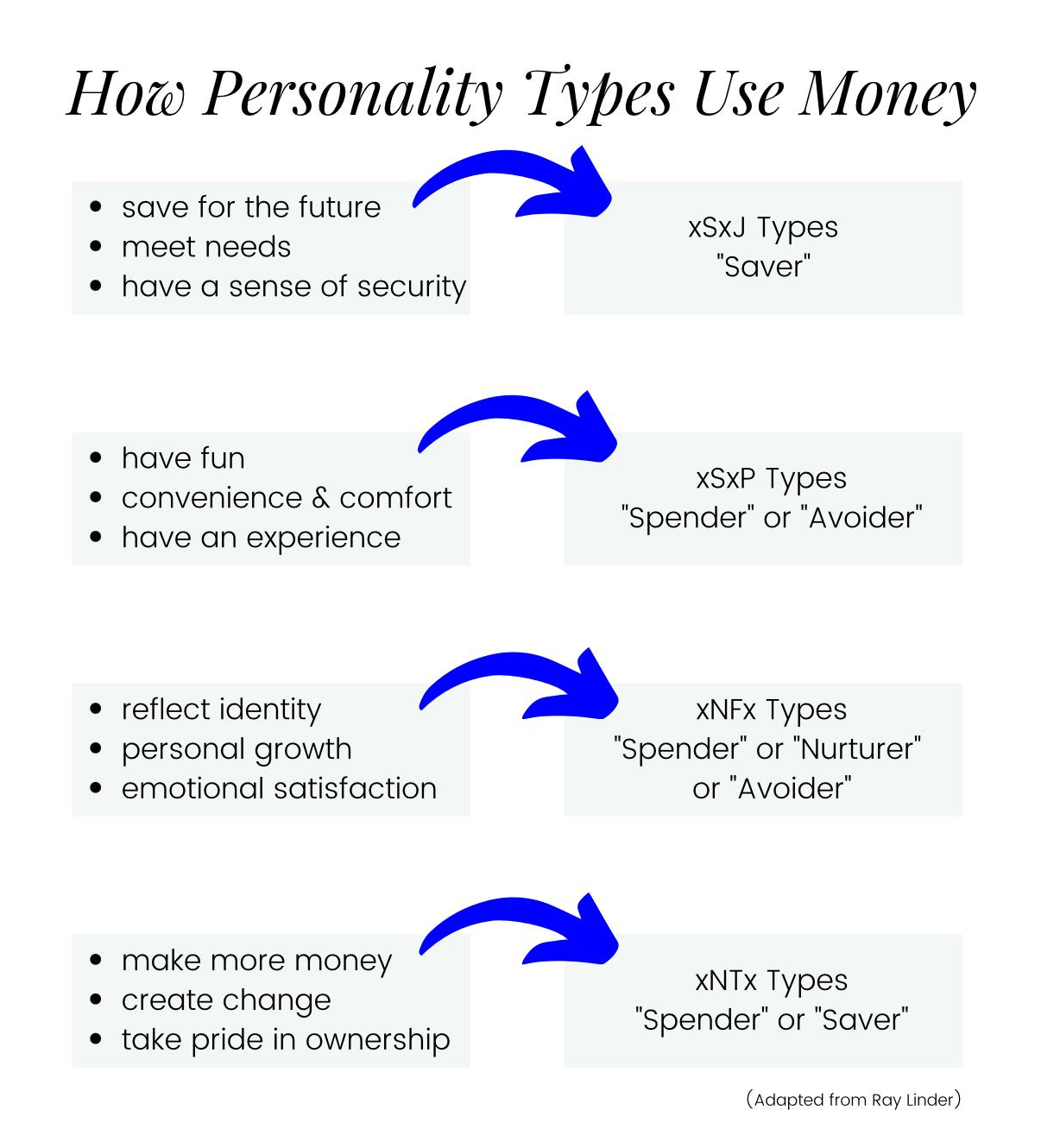
As a reminder, if you've taken my free quiz, SJ is the Stabilizer, SP is the Improviser, NF is the Catalyst, and NT is the Theorist.
Money and sex are the two biggest issues in relationship counseling. Because our attitudes to those two things were pretty much laid down during our childhood, we tend to attach strong emotional and value judgments with them, which can easily trigger conflicts.
If things get heated around money, remember each behavior serves a purpose. Get curious to understand it, then try the ACTION tips to bridge any differences. If you'd like to talk about how this shows up in your relationships, I'm here to help.